
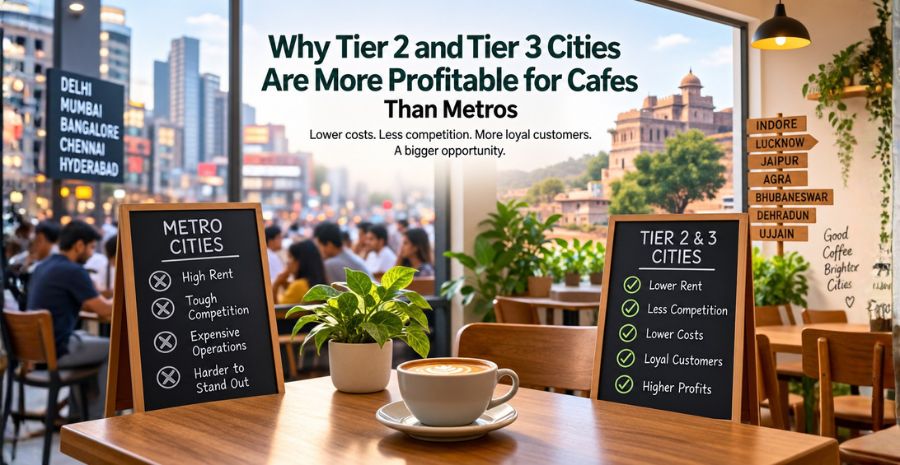
Wondering where to open your cafe? Lower rent, lower operational costs, less competition and higher loyalty are what make Tier 2 and Tier 3 cities more profitable for cafes than metro cities.
While people are still fighting to get one expensive corner in Delhi, Mumbai, Bangalore, Chennai and Hyderabad to set up their cafes, smart cafe owners are quietly building highly profitable businesses in Tier 2 and Tier 3 cities like Indore, Lucknow, Jaipur, Agra, Bhubaneswar, Dehradun, Ujjain, Alwar and Jhansi.
In 2026, the real cafe boom is not in metros; it is in India.
If you are planning to open your own coffee shop in India with a budget of 10-15 lakhs and you want profit over just popularity, this guide is for you. We will see the actual reasons, real psychology and business strategies behind why small cities are winning over metropolitan cities.
1. Rent is Lower in Non-Metro Markets
Let’s talk straight about the real challenge that any business faces in a metro city: rental charges. In any cafe business, the rent should ideally be 15% of the total revenue, which is likely to be impossible in Delhi, Gurgaon, Bangalore, Hyderabad and Mumbai.
In Metros
An 800-1000 sq ft space on a good street in a metro city can cost you approximately Rs. 1.5 lakhs to Rs. 3 lakhs or more. Plus, you will pay 6-10 months’ rent in advance as a security deposit, along with one month’s advance rent. Don’t forget the broker fees, which are usually high in Delhi, Bangalore and other metros.
According to these calculations, your first month itself will cost you somewhere between Rs. 10 lakhs and 20 lakhs, and you still haven’t bought furniture (6-7 L), interior design (10-15 L) and a coffee machine (4-6 L). This means you haven’t even started your cafe, and you are down Rs. 30-40 lakhs. You will start the month in loss.
In Tier 2 and 3 Cities
The best place to open a coffee shop in regional hubs is near the top colleges, government offices, banks or the most famous neighbourhood. The rent of an 800 sq ft space in Tier 2 cities can cost you around Rs. 70,000 to Rs. 1.5 lakhs, whereas the rent in Tier 3 cities like Ujjain, Siliguri and Rewa will be as low as Rs. 25,000 to Rs. 65,000.
You also pay a security deposit of 2-3 months’ rent only. So, your rent-to-revenue ratio remains 8-12%. This one difference makes small towns in India more profitable than metros. Including other expenses for a coffee machine, furniture and interior design, you can start your cafe in Rs. 12 lakhs to 15 lakhs in non-metro markets. So, you can break even in 4-7 months instead of 14-20 months like in metros. And this one difference changes everything.
2. Almost No Real Competition
There are several cafes in Mumbai’s Andheri within a 2 km radius. If you open one more in the locality, no one will actually notice you until you bring something unreal or exceptional. Still, there’s less chance of getting a steady flow of regular customers.
In a city like Jodhpur, Jaipur, Gwalior or Nashik, there might only be 3-4 cafes that match the vibe of metro cafes. If you open the 5th cafe in the locality with a good interior and menu, you will instantly become the talk of the town.
One of the best advantages of having your business in a monopoly market is pricing power. If you price your cappuccino at Rs. 250, people in metro cities will compare it to others. In Tier 2 cities, people will not compare, as they don’t have many options. Plus, they will happily pay you because you are providing them something unique.
3. Lower Staff and Operational Costs
Do you think hiring staff for your cafe in regional hubs is as expensive as in metros? Not really! From rent to staff, almost everything is cheaper in small towns in India.
Finding a good barista in metros can be harder than finding a customer. A trained barista can demand Rs. 30,000 to Rs. 45,000 per month in Gurgaon or Bangalore, and may still leave next month because the cafe across the street offered Rs. 2,000 more. Your training costs, uniform costs and management stress will never end like this.
In Tier 2 and Tier 3 cities, the story is different. People look for a good job in their hometown. You will find a pool of talent, like hotel management graduates and passionate youngsters who love coffee culture. You can hire them at Rs. 12,000 to Rs. 18,000 and train them.
The best part of these staff members is that they stay, unlike the staff in metro cities. Job options are limited in small towns, so employee turnover is low. They become emotionally invested in your brand. They even know regular customers by their names. You not just become their employer, but you are the person who gave them a cool, aspirational job in their own hometown.
If we talk about the overall cost of your staff in metro cities, it will be approximately Rs. 1.8 lakhs to Rs. 2.5 lakhs, whereas in emerging markets, you will pay Rs. 75,000 to 1 lakh for 2-6 staff.
4. Extremely Loyal Customer Base
Customer base and loyalty are very important factors in a cafe’s profitability in India. Customers in metros are transactional. You will see customers coming to your cafe. They take photos, have snacks and coffee, and leave. They never return because their loyalty is to Instagram trends, not to you.
But customers in small cities are relational. They don’t just come and go. When they like your place, they bring their friends and family. You will see them coming again and again, one day with their family, then their friends and colleagues. It basically becomes their go-to hangout spot.
A typical cafe in Indore has more repeat customers than a cafe in Gurgaon. This loyalty means three different types of profits for a cafe owner like you in regional hubs:
- Your customer acquisition costs become zero in a few months.
- Your business becomes predictable because you now know how many customers will come daily.
- Word-of-mouth marketing is your biggest growth source, and it’s free.
5. Lower Marketing and Influencer Costs
If you own a coffee franchise in India, you already have the advantage of an established brand name and customer recognition. But if you open an independent cafe, you will have to build your brand from scratch.
In urban cities like Delhi, you will have to spend thousands on marketing. A social media influencer or food blogger may charge Rs. 15,000 or more per reel. You will pay thousands on Instagram and Facebook ads and still may not get the required engagement. This escalates your business budget.
In small towns, famous influencers will charge approximately Rs. 2,000 to Rs. 5,000 per reel. You can even approach nano influencers who will charge a nominal fee or do a barter collaboration to promote your cafe in Gaya, Ujjain, Mathura, Udupi or Jhansi. Even a single reel can help you bring half of your target customers to your doorstep within 24 hours.
Your cafe opening is an event for the city. The local newspaper will cover it. College students will share it on WhatsApp. So basically, here you don’t need performance marketing like in metros; you need community marketing that helps you target your customers without overspending.
You will see most cafe businesses in Tier 2 and Tier 3 cities spend less than Rs. 15,000 per month on marketing and are fully packed on weekends.
6. Work-from-Cafe Culture is Booming
In Delhi, Mumbai, Bangalore or Hyderabad, working from cafes was a trend that has now become a problem. Cafes got too crowded and too noisy. A customer ordering one coffee and occupying a table for 6 hours with a laptop and a charger is a loss for the owner. That’s why most metro cafes have now started putting up “No Laptop” signs, especially on weekends.
But beyond metros, the scene is just the opposite.
In high-growth cities like Coimbatore, Lucknow, Nagpur, Indore and Jaipur, work-from-cafe culture is taking off. This is your biggest weekday profit hack.
These cities have many UPSC, CAT and NEET aspirants, freelancers and remote working professionals who have returned to their hometowns with metro salaries. They search for a quiet place with good vibes, aesthetics and a good Wi-Fi connection to work, somewhere other than their home or a crowded library.
If your cafe delivers the same required vibes, it becomes their office. They will happily order coffee with snacks and sandwiches and work for 4-5 hours. They are helpful in filling the dead hours from 11 am to 5 pm, which even remain empty in popular metro cafes.
Are There Challenges to Running a Cafe In Tier 2 and Tier 3 Cities?
We discussed how regional hubs in India are more profitable for cafes than metros, but what about the challenges cafe owners face when opening and successfully operating their business? It is not a real quick win because Tier 2 and Tier 3 cities have their own challenges.
Finding Skilled Staff
If you are looking for a trained barista in Hisar, you may not find them. The best solution for this is to train local talent. Instead of finding staff, build your own. Tie up with a local hotel management institute and start a training programme. Your first batch of students will become your loyal employees.
Supply Chain for Premium Ingredients
You may not find the same quality or type of ingredients you need for your coffee shop as cafes in metros easily get. This is because of the lack of a supply chain. For this, you should create a monthly bulk order from a Delhi/Mumbai supplier. Many suppliers have started pan-India cold chain delivery. You can also get daily milk and other perishables from a local premium vendor.
Educating the Customers
In Tier 3 cities, say Raigarh and Zirakpur, people may not know what cold brew is. So, instead of adding several international items to your menu at once, start with 70% familiar items, such as cold coffee, masala chai, burgers, fries and pasta. Keep 30% aspirational items such as lattes, cappuccino and waffles. Introduce other items slowly with the help of your menu and staff.
How to Choose the Right Tier 2/3 Cities for Your Cafe Business
In the food business, location plays a crucial role. Choosing the right location is imperative because it can either make or break your business. A great location helps attract customers naturally, while a poor location can hurt sales no matter how great your food is.
Similarly, the city where you are planning to open your coffee shop is equally important. It is true that Tier 1 cities offer higher footfall, but Tier 2 and Tier 3 cities are better because they require lower investment. Cities like Lucknow, Indore, and Jaipur have become the preferred locations for coffee business owners. Don’t pick a city randomly or just because it’s your hometown; consider the following things instead:
Student Population
Are there any universities, colleges or institutes? Basically, you will need to show that there’s an education hub, because students can provide a strong customer base for coffee shops. Cafes function as extended study spaces and community hubs for peer interactions. Plus, social media trends have heavily popularised ‘coffee aesthetics’. When you consider the student population, you increase the chances of higher footfall.
Research About Cafe Demands
Before you decide whether the city is good for you, research the demand through social media posts and trending hashtags. Search for either #kanpurcafes or #Indorefoods and see the results. If you get hundreds of posts, it means demand exists in your city. This gives you a green signal to commence your business.
Existing Competition
Do not fear the competition. It actually shows how high the demand for cafes is in the city. If there are hundreds or more cafes, the demand is high, and this doesn’t break your business; in fact, such places attract more customers and increase overall business opportunities. Check the reviews of all the cafes in the city. If only a few got good or positive reviews, it’s a green signal for you to bring something unique and best for people.
Spending Power
Cafes’ menus can be a bit expensive. You will have to ensure that people in your city are ready to spend money. If there are brands like Zara, Nike, Domino’s and KFC, it means people have money to spend. It is a good sign to open your coffee shop here.
Rental to Income Ratio
Can you find a place with a monthly rent lower than Rs. 60,000? For a business to be profitable, keeping rent under control is essential. Ideally, it should be 8-12% of your projected monthly income, but you can still consider the rent to be 15% of the monthly income, but not more than that.
Final Thoughts
The question is no longer, “Can a cafe work in small cities?” The question is now: “How long will you wait before someone else opens it?” Metro cities introduced coffee culture in India, but it’s the non-metro cities that are making it a sustainable business.
If you have a low budget of Rs. 10-15 lakhs and a passion for running your own cafe, don’t go to metros to fight a losing battle. Instead, invest in a cafe business in Tier 2 and Tier 3 cities where you can be the hero.